
Takei applies life lessons to plea to pursue ideals
By EMELINE HAWKINS
For the Northwest News
Only George Takei can greet an audience with the Vulcan sign from “Star Trek” and pull it off effortlessly.
Takei, who celebrated his 86th birthday only days earlier, finished off Purdue Fort Wayne’s annual Omnibus Series on Tuesday.
A groundbreaking actor, author and social justice activist, Takei spoke of his journey from a Japanese-American internment camp to Hollywood legend and his well-known role of Mr. Sulu on the original “Star Trek” television series.
“In that period of time, I’ve been called a lot of things, a legend, an icon, but those are all flattering exaggerations. I’ve also been called a slant eye, Jap, enemy alien,” Takei said.
Takei started with his childhood memories of the attack of Pearl Harbor, and how his and his family’s lives were changed forever.
“Terror rolled across the nation,” he said, as he documented nearly 2,400 dead, 20 warships sunk and nearly 130 aircraft destroyed in the attack Dec. 7, 1941.
Takei’s family were American born and raised, after his grandparents immigrated to the United States. His father had a successful business, but government decisions and hysterical fear would soon end with the word “Jap” defacing the Takei family vehicle.
Curfews would be soon be enforced from 8 p.m. through 6 a.m. and eventually all bank accounts and live savings belonging to Japanese-Americans would be frozen by the government.
All these decisions would eventually lead to Executive Order 9066, when nearly 125,000 Japanese-Americans on the West Coast would be taken from their homes and herded onto trains to be taken to camps surrounded by barbed wire and guarded by U.S. soldiers.
Takei’s memory of one May day struck the crowd as especially shocking, coming from the viewpoint of a 5-year-old George.
“I remember my father dressed us hurriedly and told us to wait in the living room. There’s wasn’t anything fun to do in the living room, so we looked outside the window and saw soldiers with rifles and bayonets,” Takei said.
Those soldiers would bang on the door and force them to leave their home, and would also point their rifles and bayonets at the boys, who were so afraid they froze, unable to move.
“I can remember tears streaming down my mother’s face, holding an infant in one arm and a large duffel bag in the other,” Takei said.
The family was loaded onto buses to Santa Juanita racetracks, where each family was assigned a single stall. First, Takei got sick, then his infant baby sister, but still they would reside 4 months in that horse stall waiting for camps to be built. Takei recalled the pungent smell of the horse stall and the flies that buzzed nonstop.
Eventually, after a 3-day, 2-night train trip, the family was moved to Rohwer, Arkansas, the location of their new home, a prison camp hastily built parallel to railroad tracks, with rows and rows of barracks, broken up by the occasional sentry tower.
With a manpower shortage, the government would force internees to take a loyalty questionnaire consisting of 30 questions to rate one’s loyalty. Two questions would eventually ask whether they were willing to join the U.S. military and if they would swear their loyalty to the U.S. while forswearing their loyalty to the emperor of Japan.
The questions, now described as “no-win” questions, were deceptive in nature. When his parents answered no to both questions, they were categorized as disloyal and moved to the most populated, guarded internment camp at Tule Lake, California.
Those who answered yes to those questions would eventually be drafted and many would perish in battle, with the Japanese-American 442 Regiment Combat Team becoming one of the most highly decorated units in World War II.
With the war finally over in 1945, the impoverished families were each given a one-way ticket to a destination of their choice and $25 to rebuild their lives, which would lead to Japanese-American communities being built on the East Coast and in the Midwest.
“My parents decided to go back to Los Angeles, but LA wasn’t very welcoming. Our house was on skid row,” Takei said.
With Takei’s father forced to take a job among other Asian minorities since no one else would hire him, the family lived in a one-bedroom apartment. Takei’s father would purchase an old drycleaner previously owned by a Hispanic family for cheap, build it up and make a profit.
The proximity to the Hispanic community would benefit Takei as he learned to speak Spanish. After four years of hard, long hours of work, the family would be able to buy a three-bedroom home with a small down-payment on St. Andrews Place.
As a teenager, Takei would start asking his father questions about the war.
“He shared with me his anguish and rage, of being unjustly imprisoned, but he also told me about America and democracy and the American dream. He told me the ideals of American are shining ideals such as free speech, equal justice under the law, the right to vote and to choose our representatives,” Takei said.
“He always liked to quote Lincoln’s Gettysburg Address and say ours is a government of the people, by the people and for the people and the people have to make those shining ideals true and real and strong. When the people get goaded into hysteria, they do hysterical things and that’s what happened to us during the war,” he said.
This would lead to him volunteering for various political campaigns, and his lifelong interest in politics.
As part of a campaign for redress for previous treatment, Takei would eventually speak before a congressional hearing in 1971 as one of 700 Japanese Americans. His only regret would be that his father was no longer alive to witness that moment.
“I have come to understand that as noble and as precious as our American ideals are, they can also be very fragile. Democracy can only be as good or as strong or as true as the people who make it so,” Takei read from his statement. “It is my belief that America today is strong enough and confident enough to recognize a grievous failure. I believe it is honest enough to acknowledge that damage was done, and I would like to think that it is honorable enough to provide proper restitution for the injury that was done. For in a larger sense, injury was done to those very ideals that we hold as fundamental to our American system. We, all of us as Americans, must strive to redeem those precepts that faltered years ago when I was a boy. And in that role as an American, I urge restitution for the incarceration. That restitution would at the same time be a bold move to strengthen the integrity of America.”
President Ronald Reagan eventually issued a formal apology in 1988 to the Japanese-American community, giving each surviving person $20,000.
Takei compared today’s fractured political and socio-cultural atmosphere to what he experienced as a child. He is a passionate LGBTQ activist, having lived his life as a closeted gay man at risk of not being able to advance his career until he turned 68.
“There are many issues that can be helped, but we have to live and work in our times to make a better world. We are the ones to make it happen, all of us in concert as engaged American citizens. It’s the context of time that makes it possible for a person to make change, even something you might now think is impossible,” Takei said.
Takei’s visit concluded the 27th season of the Omnibus Lecture Series, structured to bring together the “campus community and the broader Fort Wayne community to experience diversity of thought, perceptions, and experiences,” as described by a university spokesman. The five-speaker 2022-23 series lineup was announced Aug. 22, with the first lecture Sept. 14, 2022.
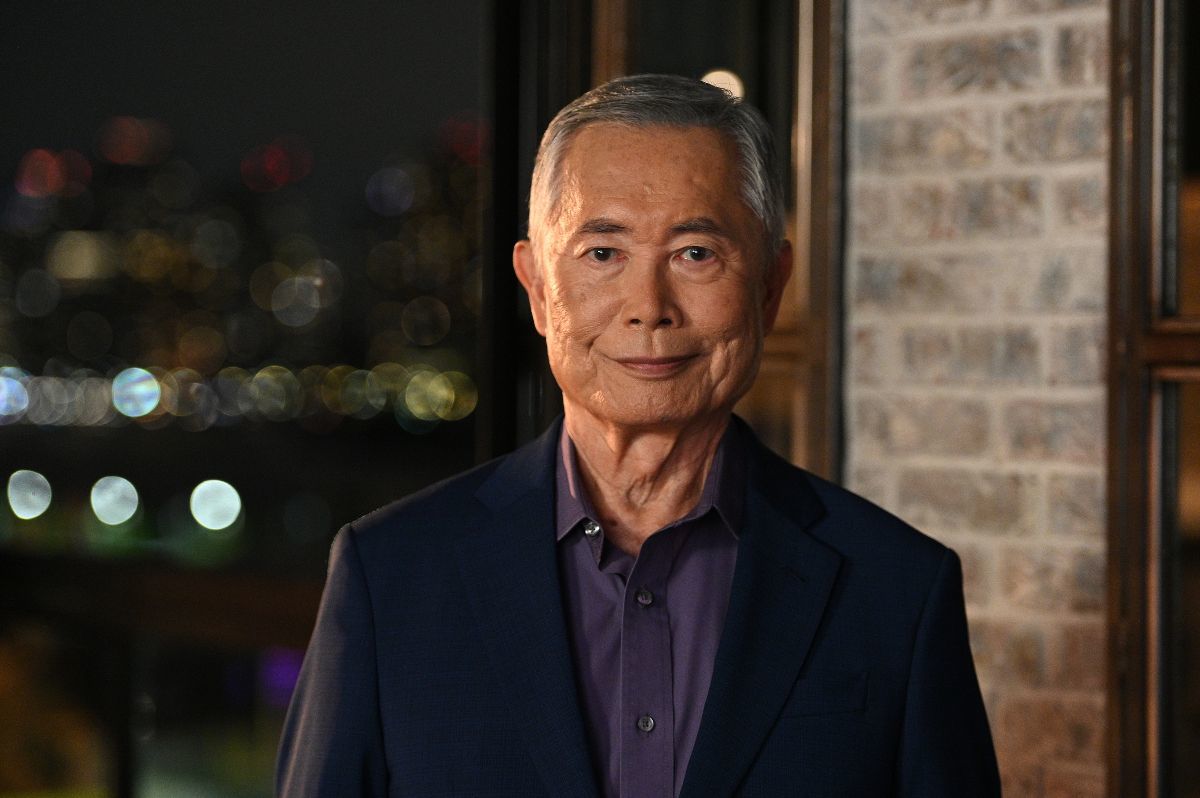
George Takei