
Aug. 20 – Fort Wayne Children’s Zoo welcomes baby Sumatran orangutan
CONTRIBUTED
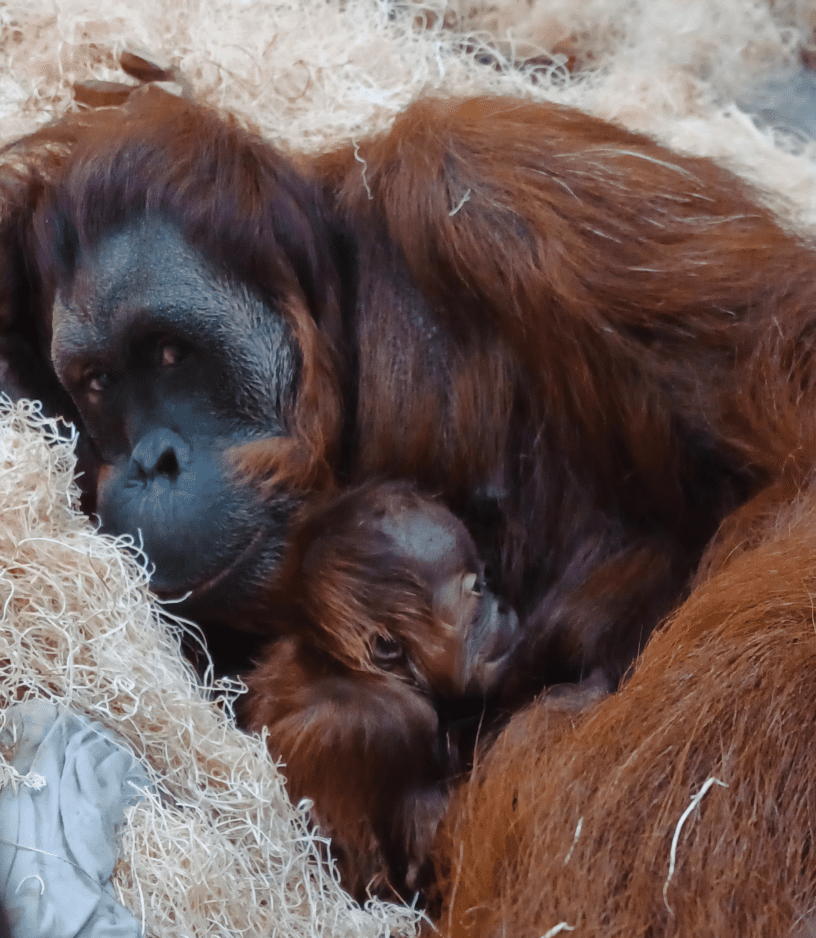
Tara, a 28-year-old orangutan at the Fort Wayne Children’s Zoo, is seen with her newborn son.
FORT WAYNE — Tara, a 28-year-old orangutan welcomed a healthy little boy at 11:13 p.m. Aug. 16.
“We are overjoyed to welcome another baby orangutan at the Fort Wayne Children’s Zoo. This marks our third orangutan birth and the second male orangutan since 2006,” Dr. Kami Fox, director of animal health & conservation, said. “Tara and baby are doing well, and we are happy to see them bonding behind the scenes.”
The zoo’s animal care team and veterinary staff have been watching Tara by remote camera overnight for several weeks. When keepers saw Tara pacing late Aug. 16 in her off-exhibit bedroom, they suspected she was in labor and arrived at the zoo to monitor the birth.
Tara’s labor lasted a few hours, and she delivered her baby unassisted.
Immediately after the delivery, Tara began cleaning her infant and placed it in her nest — a pile of wood wool and blankets — where she sleeps at night. The baby was first seen to be nursing within 90 minutes.
No name has yet been chosen for the baby. While baby and Tara bond behind the scenes, in the upcoming weeks and months, the orangutan habitat will undergo a great deal of baby proofing to create a safe space for the little one to grow. Zoo guests can expect to see bales of straw covering the floor, lower hanging vines, and may notice not all the orangutans out in their exhibit, as introductions and family bonding time happen behind the scenes.
Orangutans are pregnant for an average of 245 days, or a little over eight months. The baby’s father is Tengku, the zoo’s 37-year-old male orangutan, who arrived in Fort Wayne in 1995.
The breeding of Tara with Tengku was recommended by the Orangutan Species Survival Plan (SSP), a program of the Association of Zoos & Aquariums that seeks to maintain genetic diversity within populations of endangered animals. Tara arrived in Fort Wayne in 2013 from the Columbus Zoo. Megan Elder of Como Zoo, the International Orangutan Studbook Keeper, says that only three other orangutans have been born in North American zoos in 2023, with one being a Bornean orangutan, a different species from the Sumatran orangutans that call the Fort Wayne Children’s Zoo home.
Tengku, the only male orangutan in the local zoo’s care, and Tara are used to their parental roles, after welcoming Asmara to the world Nov. 22, 2014. Both births represent hope, as Sumatran orangutans are listed as critically wndangered by the International Union for the Conservation of Nature (IUCN) and this addition to the Species Survival Plan will further ensure the sustainability of a healthy and genetically diverse population within zoo-housed orangutans.
Zoo fans can watch for baby photos on the zoo’s Facebook, Instagram, and Twitter pages in the coming weeks.
“Orangutans grow very slowly, so this baby will still be clinging to Mom and learning to climb for a while,” Fox said. Orangutans have the longest childhood of any animal other than humans and require maternal care until they are 6 to 8 years old.
About 316 Sumatran orangutans live in zoos worldwide, and an average of 11 babies are born each year in the world’s zoos. In the wild, these red-haired apes are found only on the island of Sumatra in Indonesia, where the population is in drastic decline due to illegal hunting and the destruction of their forest homes to build palm oil plantations. Fewer than 13,800 Sumatran orangutans remain in the wild. Some experts predict orangutans could become extinct in the wild within a few decades if circumstances remain unchanged.