
July 17 – Northeast Indiana Regional Development Authority turns focus to READI 2.0
Lisa Esquivel Long
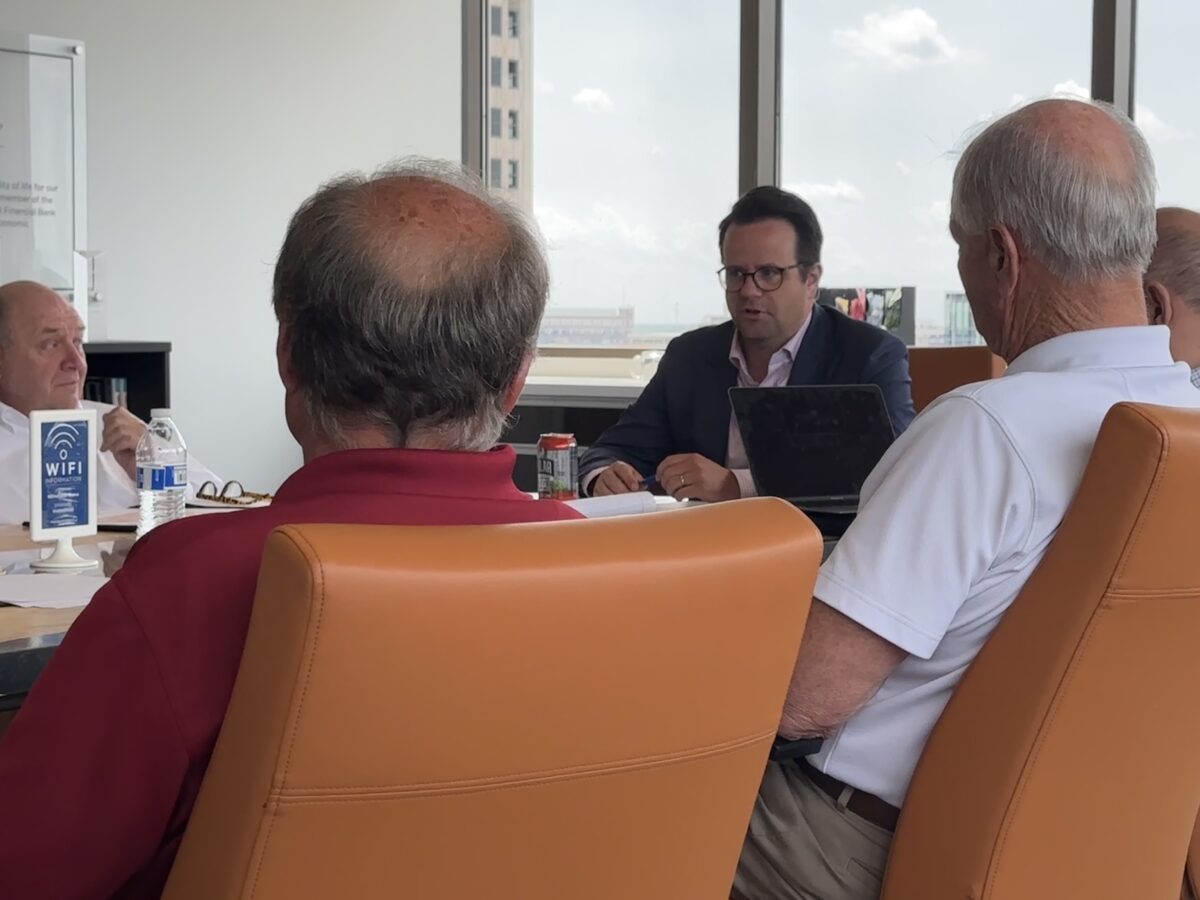
Ryan Twiss, vice president of regional initiatives for Northeast Indiana and executive director of the Regional Development Authority, center, talks to RDA members about READI 2.0.
FORT WAYNE – Earlier this year, the Indiana General Assembly set aside $500 million for what’s called READI 2.0 — another round of the Regional Economic Acceleration and Development Initiative. Aside from the announcement of the money, not much else has been discussed on the process for communities to secure a share of funds for designed for strategic investments to promote talent and economic growth.
The Northeast Indiana Regional Development Authority got an update of sorts at its July 11 meeting about a recent quarterly READI summit.
“The update is: we don’t know a heck of a lot,” Ryan Twiss, vice president of regional initiatives for Northeast Indiana and executive director of the RDA, said.
“But the window’s closing,” RDA member Bob Marshall said.
Twiss expects the process of creating the application for funds to be easier than that for the original READI program, which provided the Northeast Indiana region with $50 million in government money.
This go-around won’t involve federal money.
“Not having the federal procurement guidelines, that alone will save a ton of time educating (applicants) on what you can and can not do,” Anne Marie Murphy, director of regional initiatives for Northeast Indiana.
The timeline for when rules will be announced and applications will be due is up in the air.
“It all has to be approved by the state budget committee before they can really go public with it, and that meeting will occur in August,” Twiss said.
That means the announcement of which communities will receive READI 2.0 funding likely won’t come until the first quarter of 2024.
One thing the group knows is the match for projects must be capital, like it was for Regional Cities, which resulted in the creation of RDAs to apply for the money. That 2015 initiative resulted in three Indiana regions, including the Northeast, each getting $42 million for more than 420 projects. The Northeast Indiana region’s Road to One Million Plan — a reference to the endeavor to increase the number of residents to 1 million by 2031 — included visions for Fort Wayne’s riverfront development and trail improvements in several counties.
“We are 99% sure, like with Regional Cities, the match must also be capital, so we can’t build a university engineering building with READI money and then use the programming that happens there as a match,” Twiss said.
Match leverage will be a big factor and investment in rural communities is being talked a lot more overtly about, he said. Housing will be another focus as will partnerships with anchor institutions such as universities and industry clusters.
“It looks more like an economic development play than Regional Cities or even READI might have,” he said.
Regional Cities, in particular, was about creating “quality of place.”
This funding may also come in other forms than the previous programs.
“We’ve typically just done straight-up grants,” Michael Galbraith, RDA administrator, said.
The message has been how can the money be leveraged into the future.
Revolving loans could be on the table, Twiss said. Using housing as an example, the RDA might make a low-interest loan to a developer to do street lights and curb cuts and the match would be calculated by the houses that are sold.
The RDA has sent to the Indiana Economic Development Corporation for final approval the last of the list of projects it recommended for the first round of READI funding. During the July 11 meeting Twiss was getting updates on IEDC approval of some of those projects, which included Adams County’s M.E.R.I.T. Center in Decatur, which was approved for $285,000, and a downtown building to house Adams County Economic Development Corp.’s office as well as space for remote workers along with a community gathering space, which was approved for $290,000.